This illuminated embroidery examines inheritance,
bodily memory, and archival absence through the language of stitch.
bodily memory, and archival absence through the language of stitch.
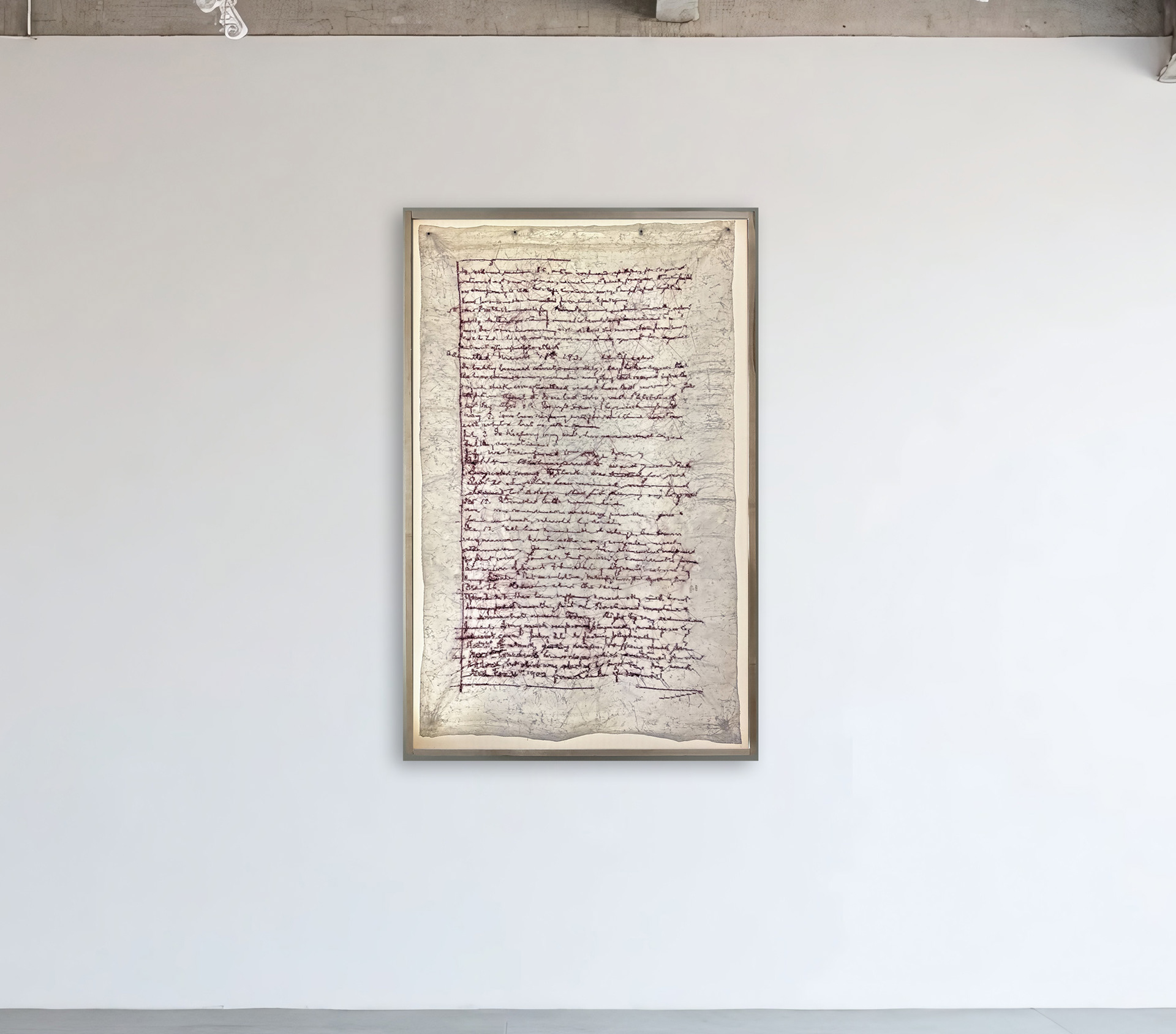
Sticky Blood (Phlebitus). 2026
Waxed Silk, Embroidery Floss, Maple, Plexiglass, Led Lights
61" x 40" x 4"
Waxed Silk, Embroidery Floss, Maple, Plexiglass, Led Lights
61" x 40" x 4"
I had a skein of ecru crochet thread mottled with brown specs, accumulated over more than a century. For years I carried it with me, moving it from place to place until it eventually found a home at the bottom of a basket of tangled threads. One day recently while feverishly searching for red embroidery floss the ecru thread and I were reacquainted. The paper wrapper was slightly torn and ornately decorated with dancing gold letters; “Daisy” mercerized Crotchet Cotton: 700 yards and had an enchanting illustration of a flower. This thread had a name and carefully designed packaging, gently holding the threads together indicating it was a material once highly valued and prized. Each strand was tightly twisted with a slight sheen, wiry, resilient, and tenacious. I noted its beauty and set it aside to include it in future work.
In the Spring of 2025, I attended a textile workshop where I needed a reference document to generate a black and white cross-stitch pattern. I had with me a copy of a medical record from the final two years of my great great grandmother; Elizabeth Tranem's life dated 1900-1902[i]. She been Institutionalized because of epilepsy or perhaps for simply being a woman deemed unmanageable. During the Victorian era Epilepsy was thought of as a moral failing, a mental illness rather than a neurological condition.[ii] This record seemed to be asking me to stitch it, to bring it to life.
Prior to her admission to the Asylum, the record stated that she came from the Victoria “Home for Incurables”[iii] a home for the destitute and infirmed [iv]. Her medical record noted that she was paranoid and believed people were conspiring to take her life. Perhaps they were, or perhaps she became unhinged by conditions that offered no reprieve. I do not know. The stories that have come to me about her are fragmented or absent like many similar cases because of gender, politics or race. Those who held power and privilege determined what parts of the story were preserved and what parts were left out.
This pattern of erasure from public narrative and character framing is not historical, it persists. Despite our vast ability to document our own stories on cellphones and social media, this is mostly still true. Recently the U.S. president Donald Trump released a statement to “truth social” hours after the death of Renee Good a mother, sister, daughter who was acting as a peaceful observer to support of her community from being wrongfully detained by masked ice officers. Trump reframed her as an aggressor, an angry woman who “violently, willfully and viscously” ran over an ice officer[v] ignoring the multitude of recordings that proved otherwise. There is an underlying tone of that has homophobic and misogynistic, consistent with the Republican party’s regression of women’s reproductive autonomy and LGBQT rights[vi]. What struck me was not only the speed with which this narrative was produced but also its familiarity. The willful and angry woman, who is unhinged and needs to be controlled and disciplined. Or in the case of Elizabeth, diagnosed and institutionalized. These ideas circulate, thicken and then harden with repetition into fact.
The word Phlebitis began to jump out from Elizabeth’s record, not knowing what it was I looked it up. Phlebitis is an inflammation of a vein that causes painful red swelling that is warm to the touch. It can result from vein injury, slow blood flow, or clotting disorders. While superficial phlebitis is usually a minor issue, it can evolve into deep vein thrombosis, which can be life threatening. It is associated with prolonged immobility, childbirth, infection, and bodily trauma[vii]. Blood clots form when blood flow is impaired or when blood becomes unusually viscous. As I stitched, I began to associate this condition Phlebitis, with how distorted and destructive perspectives like misogyny, racism and colonialism become lodged in our unconscious and re-enacted in present day. Sticky blood[viii] and sticky ideas are inheritances that resist movement and require deliberate dispersal.
And so, I began this work, my re-stitching, as an invitation for transformation extended to both myself and my materials: silk, beeswax, thread and wood. Would you like to become something new I asked? I paused and listened, allowing a space for response, a feeling to arise that indicated consent. I held the materials in my hands, coming to understand its subtle qualities through touch. I wait to see what images or thoughts come to mind. Is it a longing to return to a forest or shore of the water, to remain what it is? Or do new adventures come to mind, beeswax that reminds me of skin, a new being that is not singular but plural much like the colony of bees that produced it. Then together we begin making.
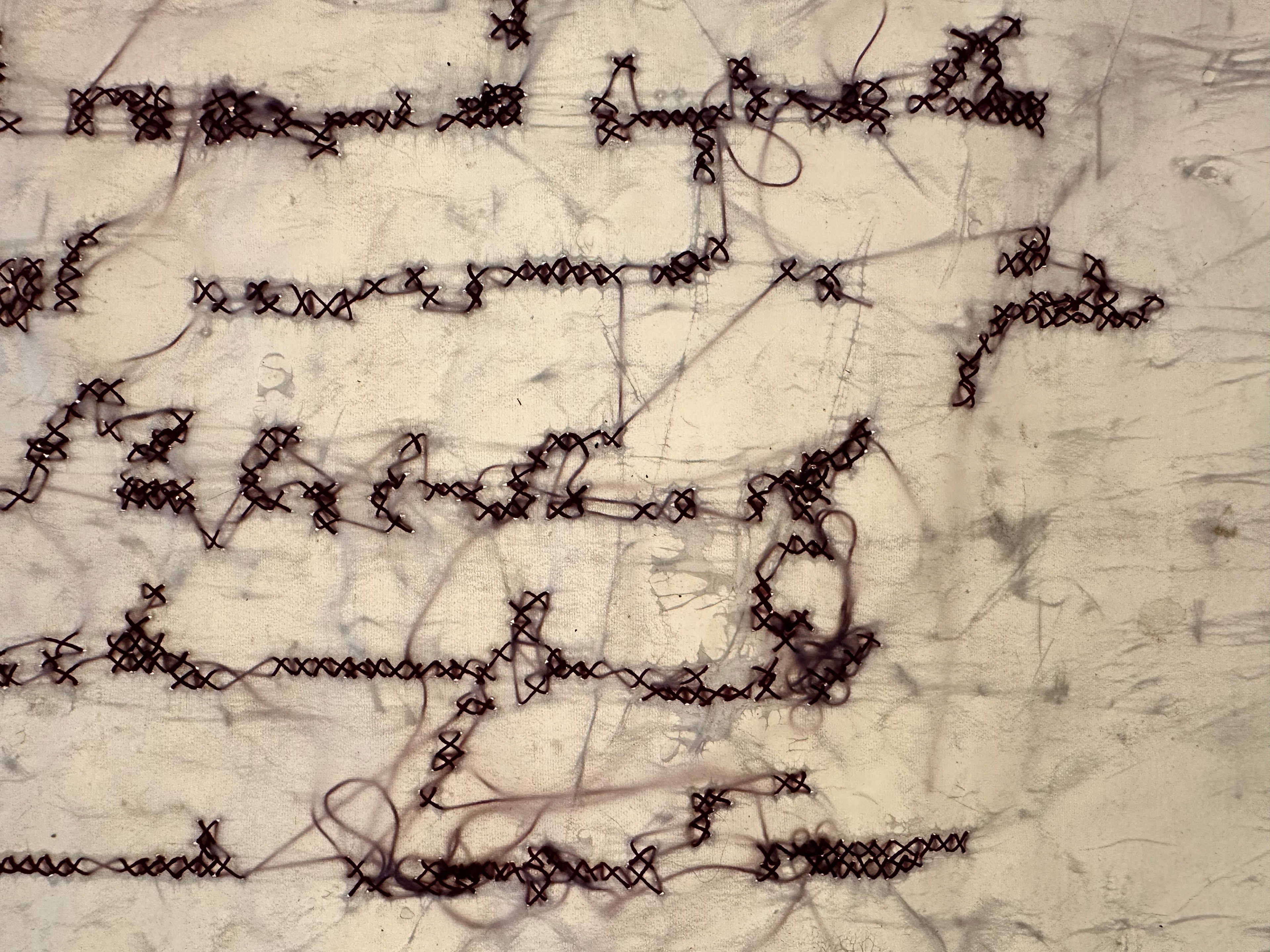
The threads were dyed a vivid scarlet red and drawn repeatedly through beeswax, giving them an animacy and liveliness. What was thread begins to resemble veins. I use silk sheets in my practice that I sew up from fabric which was once silkworm cocoons. The silkworms extrude impossibly small strands of silk from their mouths, a type of song producing a material stronger than steel by weight, which entombs them as they dissolve and transform into new beings. As I sleep, the sheets absorb my dreams and forgotten memories from me and those who came before me. From silkworms I learn how to dissolve into one’s essence and reconfigure the elements into a new being that grows wings and floats through the sky. When the cloth can hold no more, I seal this trans-generational residue within layers of beeswax. melted and painted on the sheets. I warm the distorted and uneven cloth hanging from a bar in my studio with a hair dryer. As hot air blows on the wax it softens and runs downward under gravity. I spread it on the table and iron it until when I touch it is smooth and even. The wax holds and comforts, the surface becomes transparent, a membrane between conscious and unconscious - skin.
I stitch and prick, mark make into it - the words of Elizabeth’s medical record. I am not interested in the letters as symbols (building up words for communicating) or in language (as conveyance of information). I am seeking what the letters can reveal as meaning begins to slip. The thread reveals the connection and complexity between the body and the mind. How movement and touch is a language. The threads join ghostly shapes with tangled knots and dangling ends speaking more clearly, more truthfully than the words on that medical record every could.
I photocopy Elizabeth’s records repeatedly, copies of copies, 3, 4, then 5 times, then run it through a software program that converts it into a pattern with tiny of crosses. Each iteration moves further from words, abstracted and evolving into something new. At some point I scale the words up. An Enlarged copy of the document is taped to the waxed silk. I pick up a pin and perforate the surface where letters once were. Precision is not my concern; this new language is formed through erosion rather than transcription. Every time I make a copy or move from paper to pattern, from pattern to cloth, this record; a cold statement of facts determined by a doctor that did not likely know this woman or her story becomes something new something beautiful and unrecognizable. Something closer I hope to her lived experience and others in the past, present and future communicating through stitch, cloth, wax and wood.
When I started to embroider using this vintage thread, once ecru and now blood red it felt markedly lighter than modern floss I had used previously. I noticed the stitches were plain, each individual cross clearly visible. They reminded me of a family quilt made during the Depression, with cross-stitch elements made from sewing thread instead of embroidery floss. Assembled with what was available at the time, pieced together with short bits of thread in subtle variations of blue. These small differences in colours invited closer examination. I have learned that limitations often produce methods that would otherwise remain undiscovered.
I stitch upside down, without reference. The marks are not legible words, but form patterns and abstract shapes guided by memory rather than exact reproduction. As I stitch, I light the perforated waxed silk from below so the tiny pinholes and cracks in the wax are illuminated. The process takes longer than I anticipate. When fatigue sets in, I resist the urge to stop, instead I settle into the rhythm, stretching my arm as I pull the thread. My body moves while my mind drifts, allowing me to work through that which remains inaccessible to conscious thought.
[i] Although this document has some elements of the physical symptoms and disease it lacks the context to the environment and social structure in which she lived. In this way it is missing a complete record. Ontario Archives: Admissions and Medical record for Elizabeth Tranem to the London Asylum for the Insane, March 19, 1900- November 4th, 1902.
[ii] In chapter 4 Lekka describes the emergence of Epilepsy as a neurological disorder and early associations between hysteria and epilepsy that were informed through a patriarchal lens. This early connection and association persisted in how women were diagnosed, discussed and treated within institutions. V. Lekka, V. (2015). The Neurological Emergence of Epilepsy. The National Hospital for the Paralyzed and Epileptic (1870-1895). Boston Studies in the Philosophy of Science. Vol. 305. Springer, 2015 P.101.
[iii] The Protestant Home for Orphans, the Aged and the Friendless was opened in September of 1876. This article is a summary of the evolution of some of the care facilities in the London area during the Victorian era including the Victoria Home for incurables. Initially run by the Christian’s women’s its intention was “to afford a means of reformation for every fallen women who seriously desired to amend her life”. Women paid an entrance fee with a minimum stay of one year with the intent to find them gainful employment and improve their religious and social background. In 1886 the patients were separated and a new facility the London Home for the Incurables was opened for the aged and infirmed. Arthur McClelland .Victoria Home for Incurables. The London and Middlesex Historian Volume 30, 2022 p 61-72.
[iv] V. Lekka, p 80.
[v] Donald Trump, Truthsocial.com/@realDonaldTrump January 7, 2026
[vi] Kaytlen Burns. Renee Nicole Good’s queerness isn’t an aside—it’s a key part of her story | Xtra Magazine January 13, 2026. Accessed January 26, 2026.
[vii] Siamak N. Nabili, MD, MPH Phlebitis (Thrombophlebitis) MedicineNet. Phlebitis (Thrombophlebitis) Symptoms, Types, Causes, Treatment Accessed January 26, 2026.
[viii] Sticky Blood or hypercoagulability is a condition that causes blood to clot easily causing risk for deep vein thrombosis, pulmonary embolism and stroke. Causes include a variety of genetic and non-genetic disease like antiphospholipid syndrome, cancer, medications; hormone replacement therapy, oral contraceptive and lifestyle factors such as, smoking and obesity. Is Sticky Blood Dangerous? Risks and Causes Explained. Biology insights, Aug 22, 2025. Is Sticky Blood Dangerous? Risks & Causes Explained. - Biology Insights Accessed January 26, 2026.
[ii] In chapter 4 Lekka describes the emergence of Epilepsy as a neurological disorder and early associations between hysteria and epilepsy that were informed through a patriarchal lens. This early connection and association persisted in how women were diagnosed, discussed and treated within institutions. V. Lekka, V. (2015). The Neurological Emergence of Epilepsy. The National Hospital for the Paralyzed and Epileptic (1870-1895). Boston Studies in the Philosophy of Science. Vol. 305. Springer, 2015 P.101.
[iii] The Protestant Home for Orphans, the Aged and the Friendless was opened in September of 1876. This article is a summary of the evolution of some of the care facilities in the London area during the Victorian era including the Victoria Home for incurables. Initially run by the Christian’s women’s its intention was “to afford a means of reformation for every fallen women who seriously desired to amend her life”. Women paid an entrance fee with a minimum stay of one year with the intent to find them gainful employment and improve their religious and social background. In 1886 the patients were separated and a new facility the London Home for the Incurables was opened for the aged and infirmed. Arthur McClelland .Victoria Home for Incurables. The London and Middlesex Historian Volume 30, 2022 p 61-72.
[iv] V. Lekka, p 80.
[v] Donald Trump, Truthsocial.com/@realDonaldTrump January 7, 2026
[vi] Kaytlen Burns. Renee Nicole Good’s queerness isn’t an aside—it’s a key part of her story | Xtra Magazine January 13, 2026. Accessed January 26, 2026.
[vii] Siamak N. Nabili, MD, MPH Phlebitis (Thrombophlebitis) MedicineNet. Phlebitis (Thrombophlebitis) Symptoms, Types, Causes, Treatment Accessed January 26, 2026.
[viii] Sticky Blood or hypercoagulability is a condition that causes blood to clot easily causing risk for deep vein thrombosis, pulmonary embolism and stroke. Causes include a variety of genetic and non-genetic disease like antiphospholipid syndrome, cancer, medications; hormone replacement therapy, oral contraceptive and lifestyle factors such as, smoking and obesity. Is Sticky Blood Dangerous? Risks and Causes Explained. Biology insights, Aug 22, 2025. Is Sticky Blood Dangerous? Risks & Causes Explained. - Biology Insights Accessed January 26, 2026.